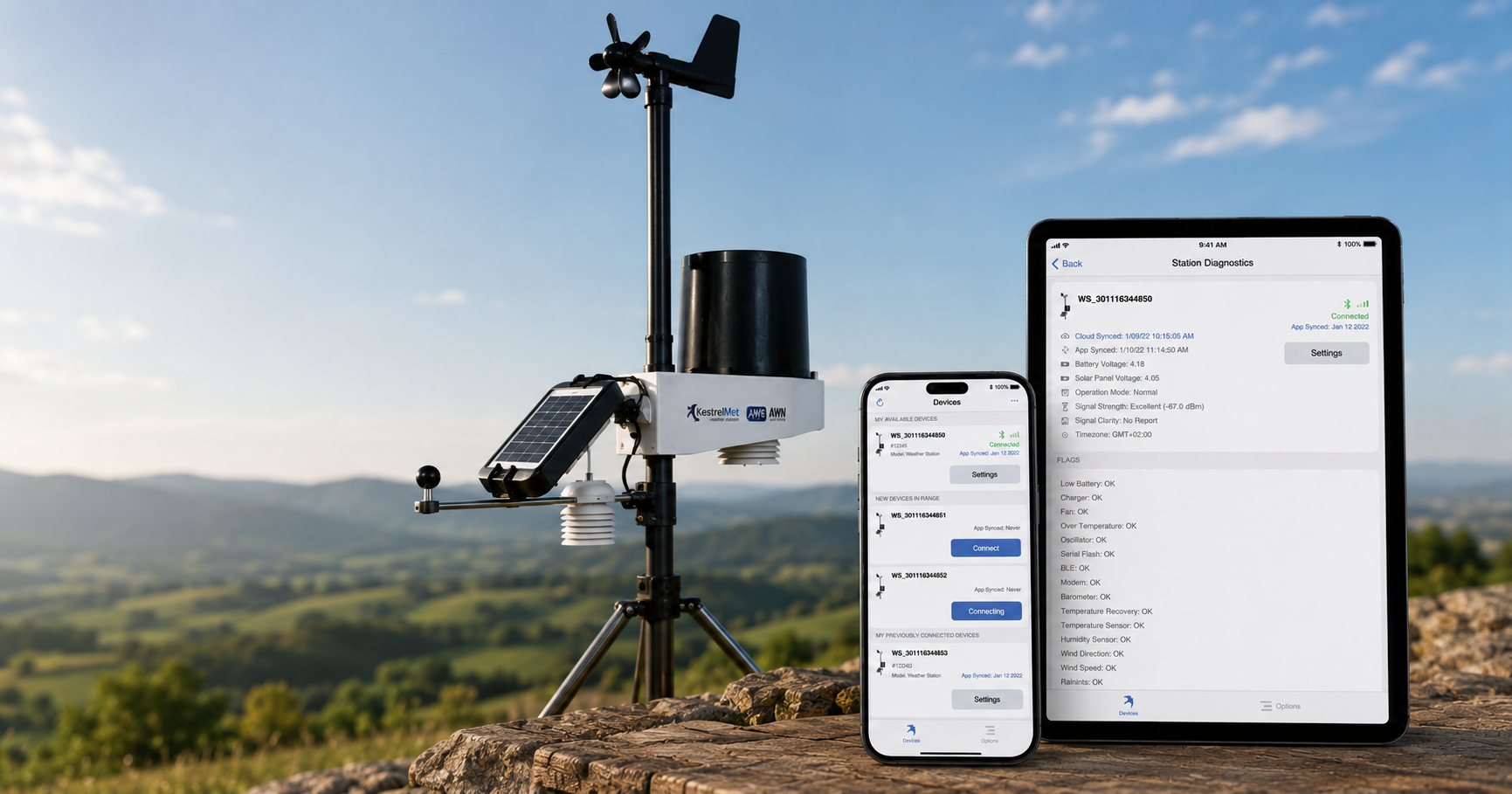
A brand-new app for a brand-new device.
KestrelMet Utility is the companion app for KestrelMet 6000 remote weather stations — professional cellular and Wi-Fi stations by Nielsen-Kellerman used for continuous environmental monitoring in agriculture, industry and field operations.
The app handles what happens before and around the data: connecting to the station, configuring SIM settings for international deployment, and reviewing diagnostics — battery voltage, solar panel voltage, sync status, signal strength and hardware health flags.
Discover, connect and manage nearby stations via Bluetooth
Essential setup for stations deployed outside North America
Battery and solar panel voltage at a glance
Sync status, signal strength and hardware flags
Who Uses It
Setting up and configuring stations on-site
Operating remote stations for continuous field monitoring
Diagnosing station health without a site visit
My Role
Unlike the other NK products I worked on, this wasn't continuing an existing app — it was designing a brand-new application for a brand-new device, from architecture to screens, while reusing the design system and components established across NK's product family.
- Designed a completely new application — new information architecture, new flows, new screens
- Defined entirely new parameters and diagnostics views specific to the KestrelMet 6000 station
- Reused and extended the shared NK design system and component library for consistency across the product family
- Designed setup and configuration flows (station connection, SIM settings) for non-technical field users
- Worked in a Scrum team with PM, business analysts, developers and QA
Challenges & Solutions
A brand-new product with no existing app to reference — architecture and flows had to be defined from zero.
→Mapped the station's setup and maintenance lifecycle first, then built the app's structure around it.
The app had to feel native to NK's ecosystem despite being entirely new.
→Reused the shared design system and components, extending them only where the new device demanded it.
SIM settings, voltages and diagnostic flags — dense technical information used on-site, often in the field.
→Organized diagnostics into scannable, plain-language statuses so issues surface immediately.